
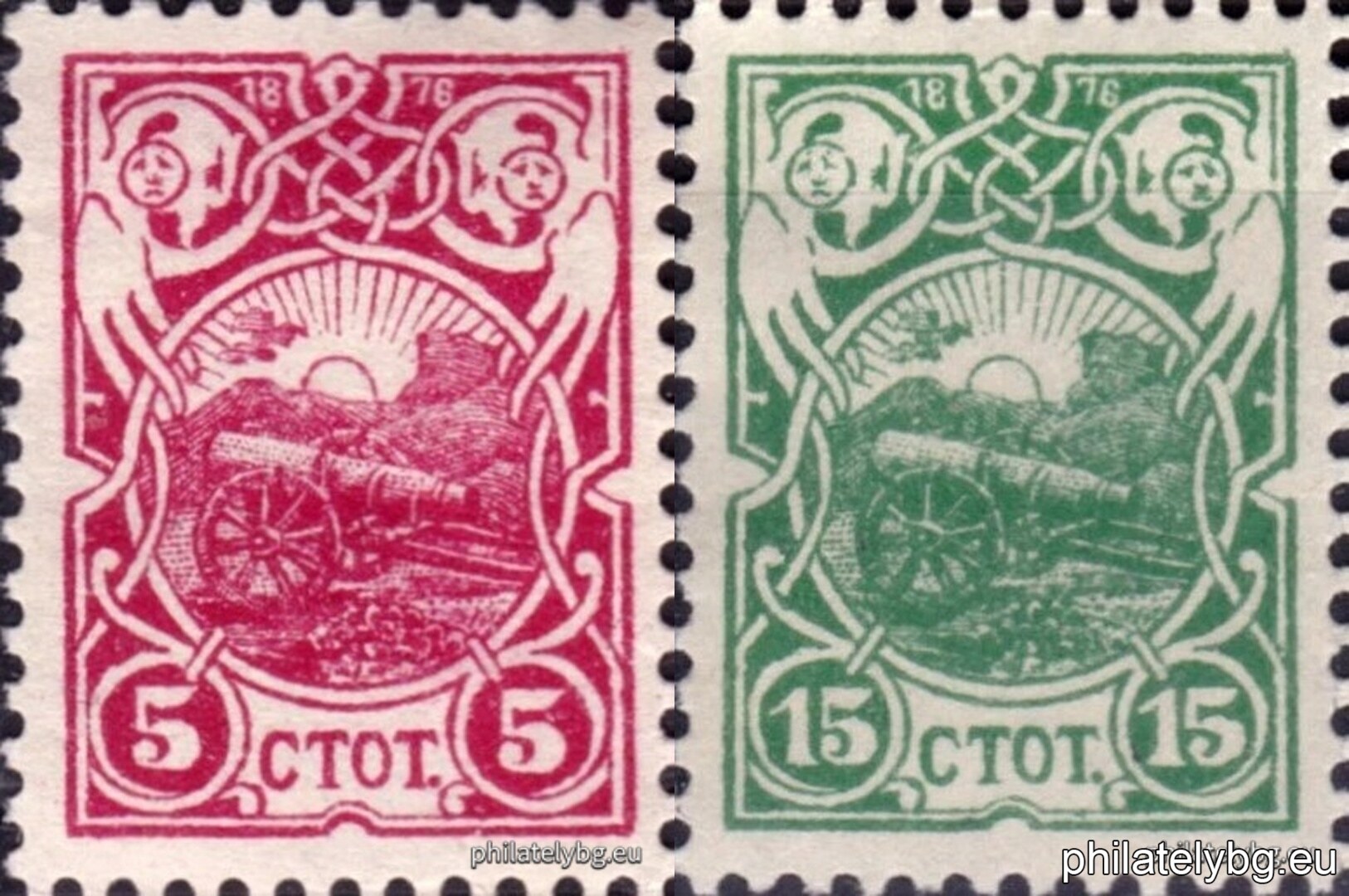
 On 20 April 1901 the Bulgarian post released two stamps, known today simply as the "Cherry-Wood Cannon" — two values of 5 and 15 stotinki, BK 51-52, from a design by the artist Haralampi Tachev. The date was no accident: exactly twenty-five years earlier, on 20 April 1876, the April Uprising broke out in Koprivshtitsa. This was the first commemorative series in Bulgarian stamp issuing, and with it the Bulgarian post joined the small number of postal administrations in the world that were producing thematic rather than purely utilitarian stamps at that time.
The image deserves quite as much attention as the date. There is no commander on the stamp, no victory and no flag over a captured fortress. There is a wooden cannon — the trunk of a cherry tree, hollowed out and bound with iron hoops. The idea for these guns was born in Panagyurishte, the capital of the Fourth Revolutionary District, where the rebels had neither artillery nor any means of obtaining it, and so made their own out of what grew around them. The trial cannon they tested outside the town burst at the very first shot.
In the fighting itself the cherry-wood cannons managed two or three shots before splitting apart. As weapons they were useless — and the rebels who built them knew it. Yet a quarter of a century later the young Bulgarian state chose precisely these guns for the first stamp with which it set out to tell its own history to the world.
That choice is where the whole meaning lies. A stamp is a miniature official document: it passes through approval, it is printed in quantity, and it travels beyond the country's borders stuck to envelopes addressed abroad. Whatever the state puts on it, the state declares to be its own face. In 1901 Bulgaria was telling the world not "we won" but "we rose, although we had nothing to rise with". The April Uprising was crushed brutally within weeks, yet it was the uprising that placed the Bulgarian question before European public opinion and set in motion the road to Liberation. The cherry-wood cannon is the most precise possible symbol of that: a failure as a weapon, decisive as a gesture.
For a collector the series is interesting on several levels at once. As the first commemorative issue it is essential to any classic Bulgarian collection. As thematic material it fits equally well into a collection on the National Revival, on military history, or on the history of stamp issuing itself. And in postal history terms it is worth looking not for a stamp torn off, but for a complete cover — especially one that travelled in the days around 20 April 1901, when the cancel dates the item precisely within the anniversary the stamp was issued for. Such a cover carries three layers of information at once: the event of 1876, the commemoration of 1901, and the real postal journey of the letter.
If you are starting a collection and looking for a theme with a clear thesis, here is one ready-made: how the Bulgarian state portrayed itself on its own stamps in the first decades after Liberation. The cherry-wood cannon is the natural opening of that story. The next chapter follows just one year later — in 1902 came the series marking the 25th anniversary of the battles at Shipka.